

FAME additive for improved low-temperature flowability of biodiesel fuel, contributing to carbon neutrality.


FAME additive for improved low-temperature flowability of biodiesel fuel, contributing to carbon neutrality.
Improve low-temperature flowability of FAME biodiesel and renewable diesel.
Sanyo Chemical’s NEOPROVER® series is designed to improve the cold-flow performance of renewable fuels for diesel engines. The portfolio includes solutions for FAME biodiesel from different feedstocks and a newly developed grade for renewable diesel, also known as hydrotreated vegetable oil (HVO).
By tailoring the additive to the fuel composition and crystallization behavior, NEOPROVER helps address cold-flow problems such as loss of fluidity and fuel-filter plugging at low temperatures.
| Grade | Target fuel | Primary application | Status |
|---|---|---|---|
| HBF-101 | FAME biodiesel | Used cooking oil and mixed feedstocks | Current product |
| HBF-201 | FAME biodiesel | Soybean oil | Under development |
| HBF-301 | FAME biodiesel | Palm oil | Under development |
| HBF-151 | Renewable diesel | HVO | Under development |
Actual performance and optimum treatment conditions should be evaluated using the specific fuel, because cold-flow behavior varies with fuel composition and feedstock.
NEOPROVER HBF-151 is a cold flow improver under development specifically for HVO. It was designed around the low-temperature properties and crystallization behavior of the paraffinic hydrocarbons in renewable diesel.
Sanyo Chemical testing has demonstrated cold-flow improvement across multiple HVO samples. Application studies and commercialization evaluations are underway. Contact us to discuss evaluation samples for your renewable diesel application.
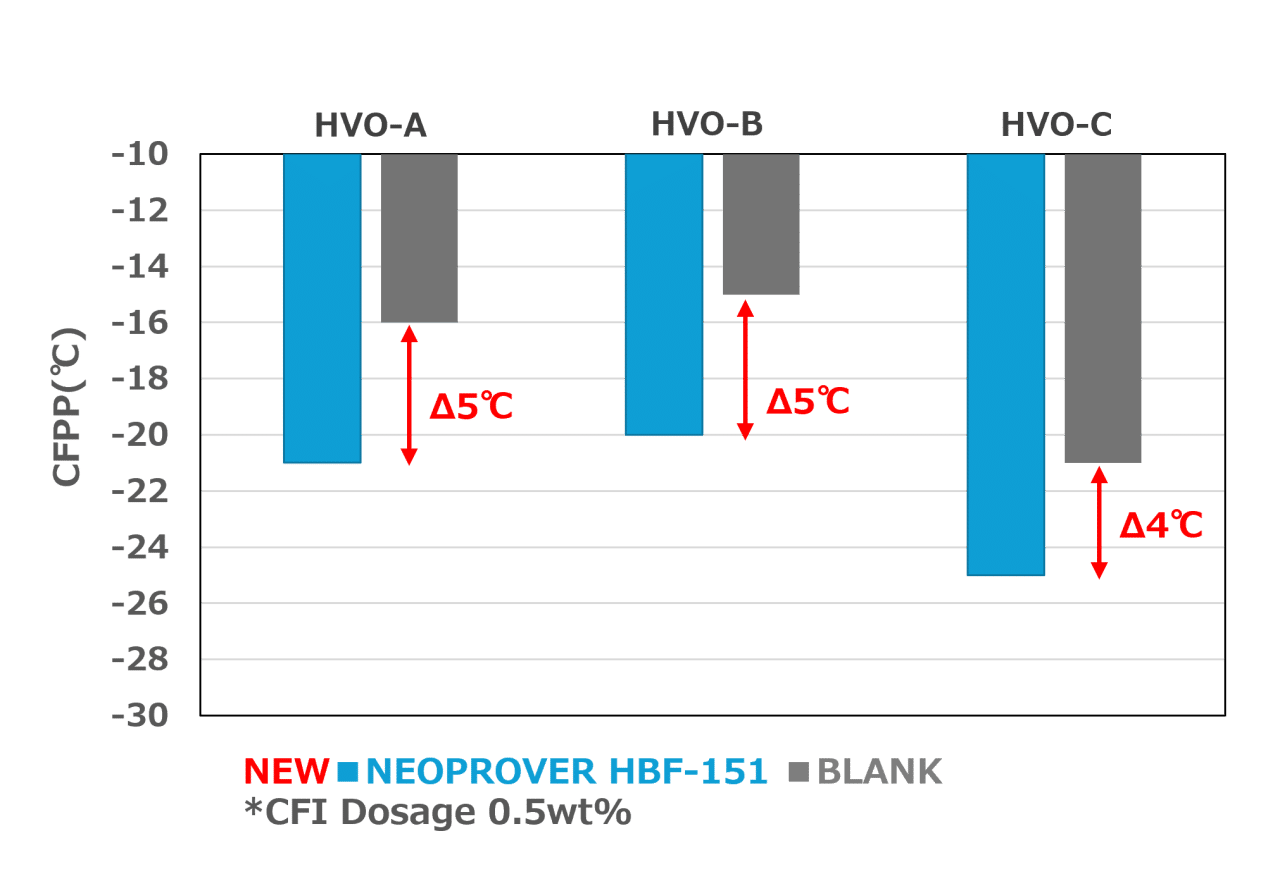
Figure 1. Effect of NEOPROVER HBF-151 on various HVO samples
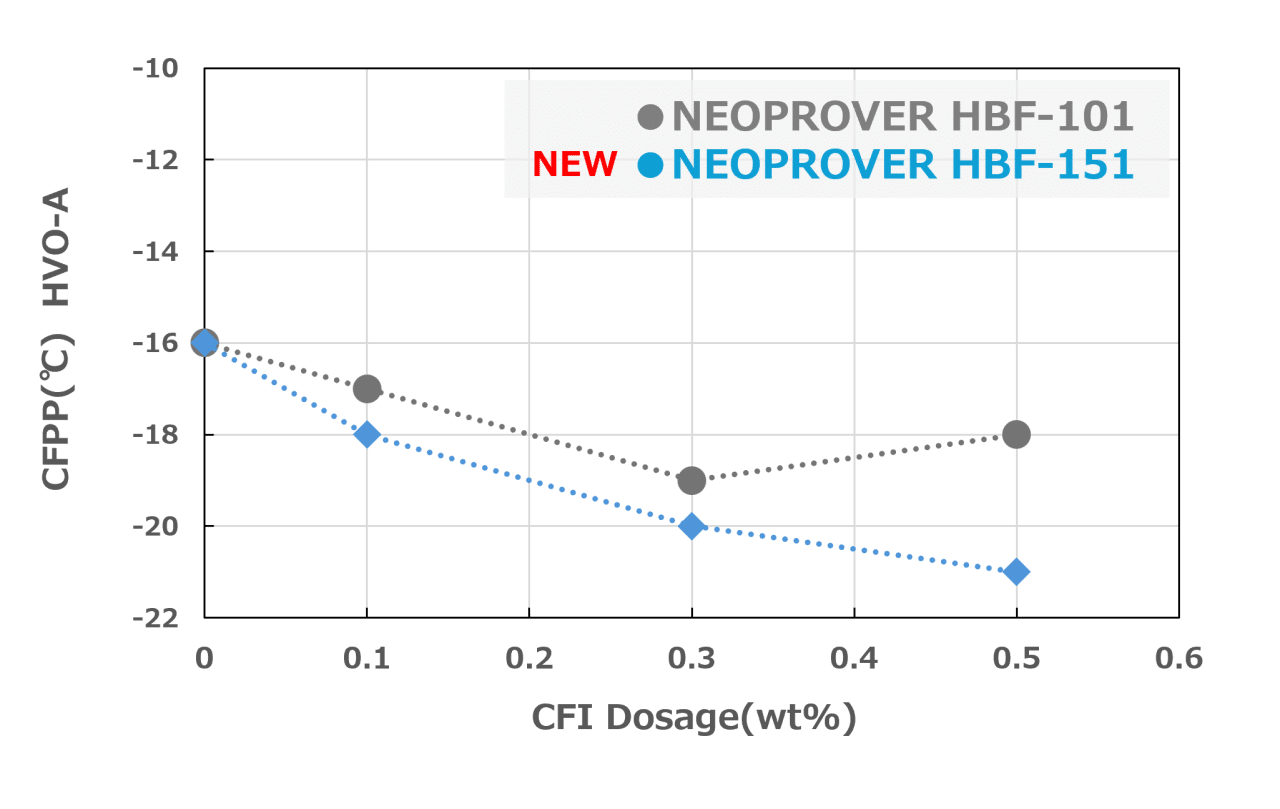
Figure 2. Cold-flow performance of HVO with NEOPROVER HBF-151
Biodiesel (FAME) and renewable diesel (HVO) are two different types of biofuel. Their chemical structures differ significantly, which affects their low-temperature properties and the selection of suitable cold flow improvers.
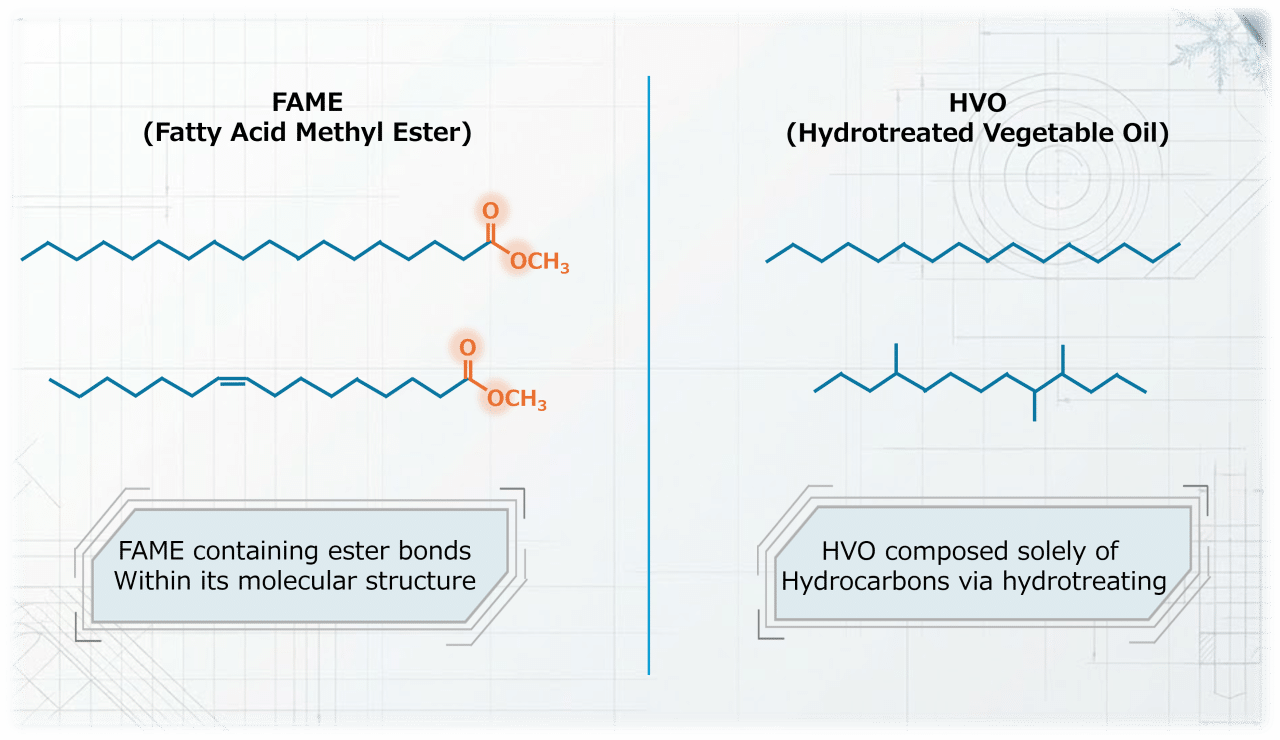
Renewable fuels for diesel engines can be produced from feedstocks such as soybean oil, palm oil, used cooking oil (UCO), and other fats and oils. Two important types are fatty acid methyl ester (FAME) biodiesel and hydrotreated vegetable oil (HVO), commonly referred to as renewable diesel in North America.
| Fuel characteristic | FAME biodiesel | HVO renewable diesel |
|---|---|---|
| Main chemical components | Fatty acid methyl esters | Paraffinic hydrocarbons |
| Production route | Transesterification of oils and fats | Hydrotreatment of oils and fats |
| Cold-flow considerations | Strongly influenced by the fatty acid composition of the feedstock | Different crystallization behavior from FAME; performance should be evaluated for the specific HVO |
| NEOPROVER grades | HBF-101, HBF-201 and HBF-301 | HBF-151 |
FAME and HVO differ in chemical structure and crystallization behavior. An additive selected for one fuel should therefore be evaluated before use in another.
At low temperatures, components in biodiesel and renewable diesel can crystallize. Crystal formation can reduce fuel flowability and contribute to plugging of filters and fuel-system components. Cold flow improvers (CFIs) modify crystallization behavior to help maintain fuel flow at lower temperatures. The appropriate product and dosage depend on the fuel being treated and the required performance.
The cold filter plugging point (CFPP) is a measure of low-temperature filterability under specified test conditions. A lower CFPP indicates improved performance in that test. In the illustrated Sanyo Chemical tests on FAME biodiesel, NEOPROVER reduced CFPP by approximately 2–4°C. This range describes the reported test results and is not a guaranteed reduction for every fuel.

Figure 4. Effect of NEOPROVER on CFPP and low-temperature flowability of FAME biodiesel
Test method: CFPP in accordance with JIS K 2289. Results depend on fuel composition, additive dosage, and test conditions.
NEOPROVER HBF-101 is designed for FAME biodiesel, including fuels derived from used cooking oil. It has demonstrated cold-flow improvement across a variety of FAME samples and is a starting point for evaluating UCO-based and mixed-feedstock fuels.
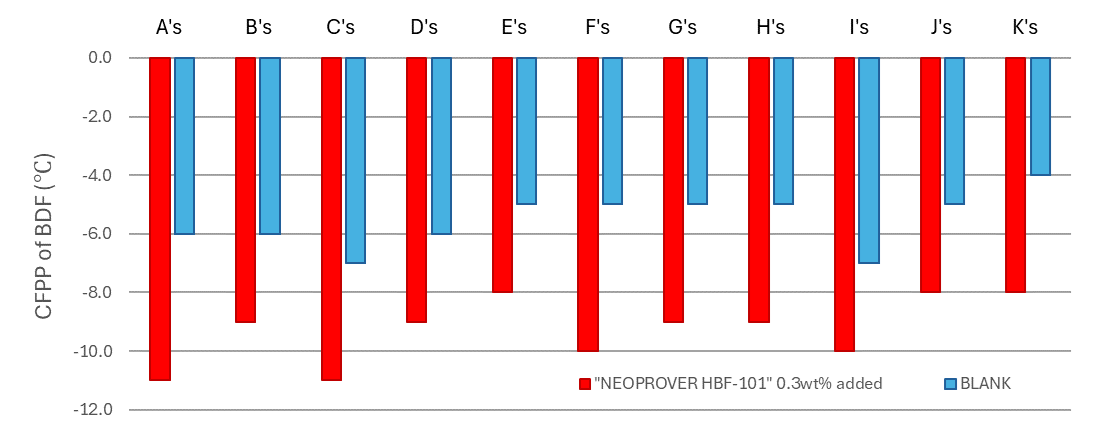
Figure 5. Effect of NEOPROVER HBF-101 on Japanese FAME biodiesel samples
NEOPROVER HBF-201 is under development for FAME biodiesel derived from soybean oil. The formulation is tailored to the crystallization characteristics of soy-based FAME. Laboratory testing is evaluating performance and application conditions.

Figure 6. Effect of NEOPROVER HBF-201 on soybean-based FAME biodiesel
NEOPROVER HBF-301 is under development for palm-based FAME biodiesel. Palm-derived FAME can present significant cold-flow challenges because of its fatty acid composition. HBF-301 is being evaluated as a tailored solution for these fuels.
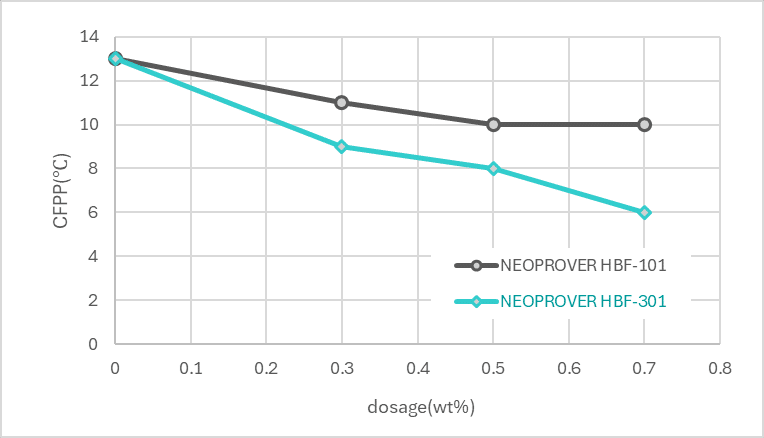
Figure 7. Effect of NEOPROVER HBF-301 on palm-based FAME biodiesel
The cold-flow properties of FAME biodiesel vary with feedstock composition. Sanyo Chemical is expanding the NEOPROVER series to provide additives suited to different renewable fuel types and feedstocks.
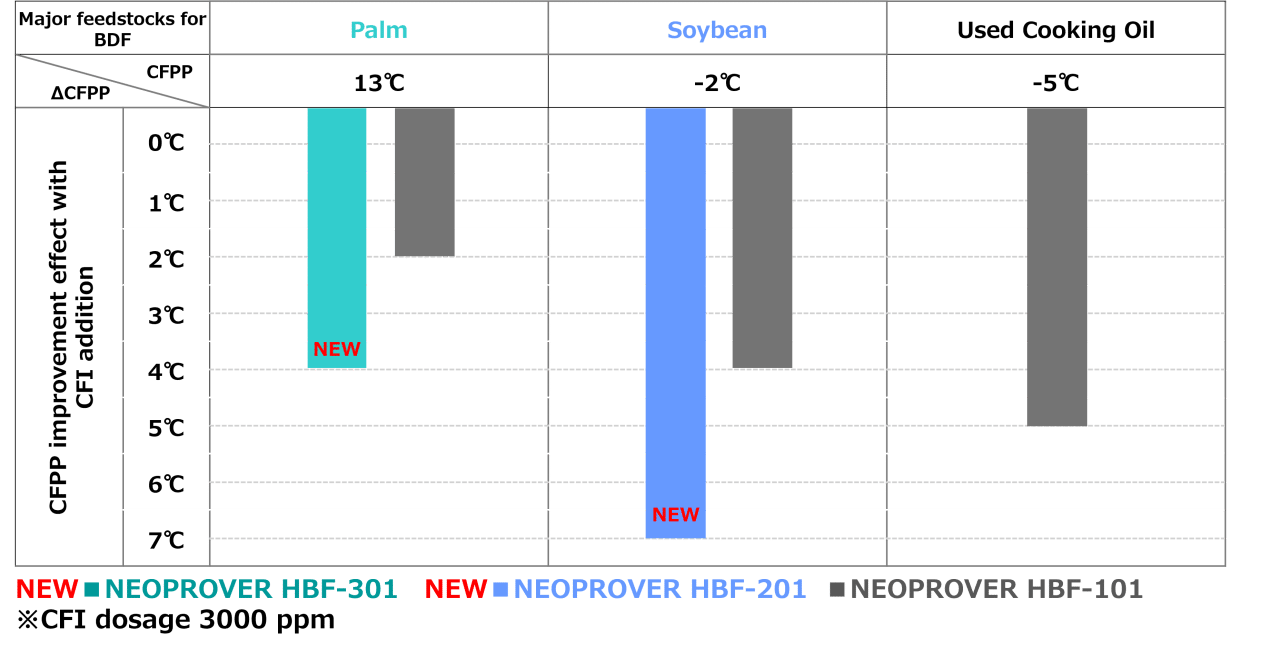
Figure 8. Performance of cold flow improvers across FAME fuels derived from different feedstocks. The results shown apply to the fuels, additive dosages, and test conditions presented in each figure. Evaluate the selected grade using your own fuel.
| Property | HBF-101 | HBF-201* | HBF-301* | HBF-151* |
|---|---|---|---|---|
| Target fuel | FAME / UCO | FAME / Soy | FAME / Palm | HVO |
| Density at 15°C (g/cm³) |
0.91 | 0.91 | 0.90 | 0.90 |
| Kinematic viscosity at 100°C (mm²/s) |
165 | 60 | 60 | 64 |
Appearance for all four grades: pale yellow to yellow liquid.
Density: JIS K 2249. Kinematic viscosity: JIS K 2283.
*HBF-201, HBF-301, and HBF-151 are products under development. Values are representative and are not product specifications. Properties and application conditions for development products are subject to change.
A: NEOPROVER is designed to work with Biodiesel (FAME) and renewable diesel made from Hydrotreated Vegetable Oil (HVO). It enhances the flowability of BDF and renewable diesel in cold weather as a Cold Flow Improver.
HBF-101, HBF-201, and HBF-301 are intended for different types of FAME biodiesel, while HBF-151 is under development specifically for HVO.
A: A Cold Flow Improver (CFI) is an additive used in biodiesel, renewable diesel, and other fuels to enhance flowability at low temperatures. CFIs are also known as cold flow modifiers, winterizing agents, anti-gel additives, and low-temperature flow enhancers. They are used to help maintain fuel performance and reliability in cold climates.
A: NEOPROVER uses methacrylate copolymer technology. Methacrylate copolymers are a type of PMA (polymethacrylate), a polymer made from methacrylate esters.
A: In addition to the methacrylate copolymer type, the EVA type is also well known. PMA and EVA products may show different flow enhancement performance depending on the fuel composition and application. The appropriate CFI should be selected and evaluated using the specific fuel.
A: When BDF crystallizes, a CFI can prevent the crystals from elongating, thereby improving low-temperature flowability. NEOPROVER functions as a winterizing agent and can help maintain smooth flow and reduce the risk of filter clogging. It can also be referred to as an anti-gel additive for BDF.
HVO has a different chemical structure and crystallization behavior from FAME. Therefore, cold-flow improvement for HVO may require an additive specifically designed for renewable diesel, such as NEOPROVER HBF-151 under development.
A: Not all FAMEs have poor low-temperature flowability. However, FAMEs made from raw materials with high amounts of saturated fatty acids, especially long-chain fatty acids, have high crystallization temperatures, leading to poor low-temperature flowability. Crystals that form at low temperatures can also clog filters.
A: NEOPROVER performs effectively as a CFI because it helps prevent crystals from elongating when BDF crystallizes, thereby improving low-temperature flowability and helping prevent filter clogging. We have developed a CFI suitable for BDF based on our extensive experience in developing additives for lubricating oils. NEOPROVER HBF-101 is designed for FAME made from used cooking oil, which is a mixture of various bio-based oils, making it effective for a wide range of FAMEs.
A:HVO consists primarily of paraffinic hydrocarbons and has a different chemical structure and crystallization behavior from FAME biodiesel. For this reason, additives designed for FAME are not necessarily optimized for HVO. NEOPROVER HBF-151 is under development specifically for HVO renewable diesel.
A: The best starting grade depends on your fuel type, feedstock composition, current cold-flow properties, and target performance. For FAME biodiesel, commercially available HBF-101 can serve as a practical starting point and benchmark, particularly for fuels based on used cooking oil and mixed feedstocks. HBF-201 and HBF-301 are development grades intended for soy-based and palm-based FAME, respectively, and may be considered depending on the fuel and evaluation objective. For HVO renewable diesel, HBF-151 is the grade under development for this application. Final grade selection should be determined based on testing with the specific fuel.
A: Please contact Sanyo Chemical America to discuss evaluation samples. HBF-101 is often used as a benchmark for FAME biodiesel evaluations, and HBF-151 may be available for HVO renewable diesel evaluations. Evaluation samples of HBF-201 and HBF-301 may also be considered on a case-by-case basis, depending on the evaluation purpose, fuel, application, and anticipated volume.
